SARAI PARKS

Food deserts in Indianapolis
PROBLEM
Across the US, many low-income communities lack access to fresh food due to car-dependent city planning. In Indianapolis alone, 42% of neighborhoods are considered food deserts.

Distance to Grocery Store
1.png)
1.png)
1+ Mile
3-5 Miles
1.png)
UDSA Food Desert Threshold
Typical Distance to Nearest Grocery Store
Based on USDA definitions and local estimates
RESEARCH
TARGET MARKET
Far East Side residents live in one of Indianapolis’s identified food deserts. This majority Black and Brown community faces fewer resources and less access to fresh food than many other parts of the city.
GAPS

43%
Food Access
9
WALK SCORE
10 = Worst Score
27%
Poverty Rate
$37.7K
Household Income
24%
Higher Education
.png)
ACCESS TO FOOD
Transit access exists, but requires time, effort, and transfers to reach essential resources, while nearby options are primarily small markets with limited hours and corner stores.


DESIGN INTENT
Design a fresh food vending system that provides food access in underserved areas, through existing bus stop infrastructure as they are already part of daily routines.
FAR EASTSIDE BUS STOPS
Bus stops follow outdated Indygo models and feel disconnected from surrounding resources.


DESIGN GOALS


Simple & Intuitive
Fits Existing Infrastructure
ADA
Friendly
Durable & Easy to Maintain
Quick
Interaction
CONCEPT DEVELOPMENT
VOLUNTEER SYSTEM


Food Collection
Volunteers collect surplus food
from grocery stores, restaurants,
& farms (food bank model).
Preparation Hub
The food is brought to a prep
hub where volunteers check,
portion, & prepare the food.
Machine Loading
Prepared food is loaded in
the vending machines daily.
USER SYSTEM


User Access
Register online or at community centers to receive a card.
Session Start
Scan Waypoint card to begin session at the machine.
Food Selection
Browse and choose items using
the touchscreen interface.
Retrieve Food
Browse and choose items using
the touchscreen interface.

Use Sliding Tray
Pull out the tray and place containers securely on it.


Take a Bag
Retrieve a Waypoint bag
and place it on the hooks.
Pack Bag
Transfer the food containers
from the tray into the bag.
Food Pickup
Collect packed bag
and take food.
INSPIRATION
.png)
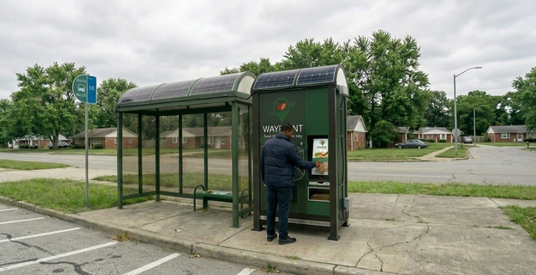
Inspired by the transit infrastructure, Waypoint reflects the form of bus stops through vertical supports, curved tops, and grounded bases to feel familiar within its environment.
IDEATION
Thumbnail sketches exploring aesthetics across locker & vending concepts, with a focus on vending.
.png)
EXPLORATION
.png)
CONCEPT
.png)
TECHNICAL DEVELOPMENT
POWER SYSTEM
Based on input from an electrical engineer, Waypoint uses 5, 150 W monocrystalline flexible solar panels, with a battery storing solar energy for nighttime use, making the system off the grid.

Solar Panels
150 Watts x 5
Charge Controller
~10 Watts
Battery
~3 kWh storage
Compressor
~120-180 Watts
Screen
~20 Watts
Lighting
~5 Watts
ENERGY PRODUCTION
The system is balanced for daily use, with energy production matching daily consumption.
Solar Panels
~150-200 Watts
~3 kWh/day
ENERGY PRODUCED
~750 Watts Peak Output (Indiana Sunlight)
~3 kWh/day
.png)
MATERIALITY

Powder Coated Steel
Exterior
Plastic Polycarbonate
Pickup Tray window
Tempered Glass
Display
DESIGN SOLUTION
WAYPOINT. FRESH FOOD ALONG THE WAY.
Waypoint meets people where they are in their everyday routines, supporting their journey by making fresh food more accessible along the way.


The Fresh Food
The Journey
The Point of Connection

PACKAGING
Kraft paper + paperboard packaging
Secure and recyclable storage.
PET Plastic Lid
Most recycled plastic globally
Kraft Paperboard
Durable & eco-friendly
Kraft Paper
Fits 3 stacked containers
10"
10"
6"
5.5"
8"
3"
Durable & eco-friendly
DISPLAY

Scan card to begin. The system verifies the users and shows daily food limit.

Select a category: Produce, protein, or staples.
Choose an item and add it to the cart for each category.
Items change regularly to give users a sense of choice similar to grocery shopping and are kept at 30-40° refrigeration.

Review cart and confirm the order.
Items dispense and the user collects their food.

DISPENSING
Users receive 3 separate containers per order. Items stay fresh and can be mixed at home.
Produce
Your selected produce.
Protein
Your selected protein.
Staple
Your selected staple.

Packed Separately
Packed Separately
Packed Separately
DIMENSIONS
52"
Shelter Alignment
Matches typical IndyGo
shelter height at 90”.
Familiar Depth
32” depth like standard
vending machines.
Accessible Design
Follows ADA guidelines
for user reach.
32"
90"

INDYGO Bus Stop Dimensions
132” × 72” × 90”
48” (ADA Max Height)
15” (ADA Min Height)
TOUCH SCREEN & SCANNER
Model Modified with Vizcom AI


The touchscreen displays instructions, while the scanner reads the Waypoint card to begin and access the system.
PICK-UP COMPARTMENT
Model Modified with Vizcom AI

The pick-up compartment allows users to retrieve dispensed items through a drop-down door.

SLIDING TRAY & BAGGING
Model Modified with Vizcom AI

The bag compartment holds kraft bags for carrying items, using nighttime motion-sensor lighting. The sliding tray supports bagging.

SOLAR PANELS
Model Modified with Vizcom AI

Solar panels generate power for the system, with wiring directing energy to internal components.

Full Design
Modified with Vizcom AI
Waypoint was intentionally designed to blend with existing shelters, rather than stand out with attention grabbing aesthetics.


Modified with Vizcom AI
